
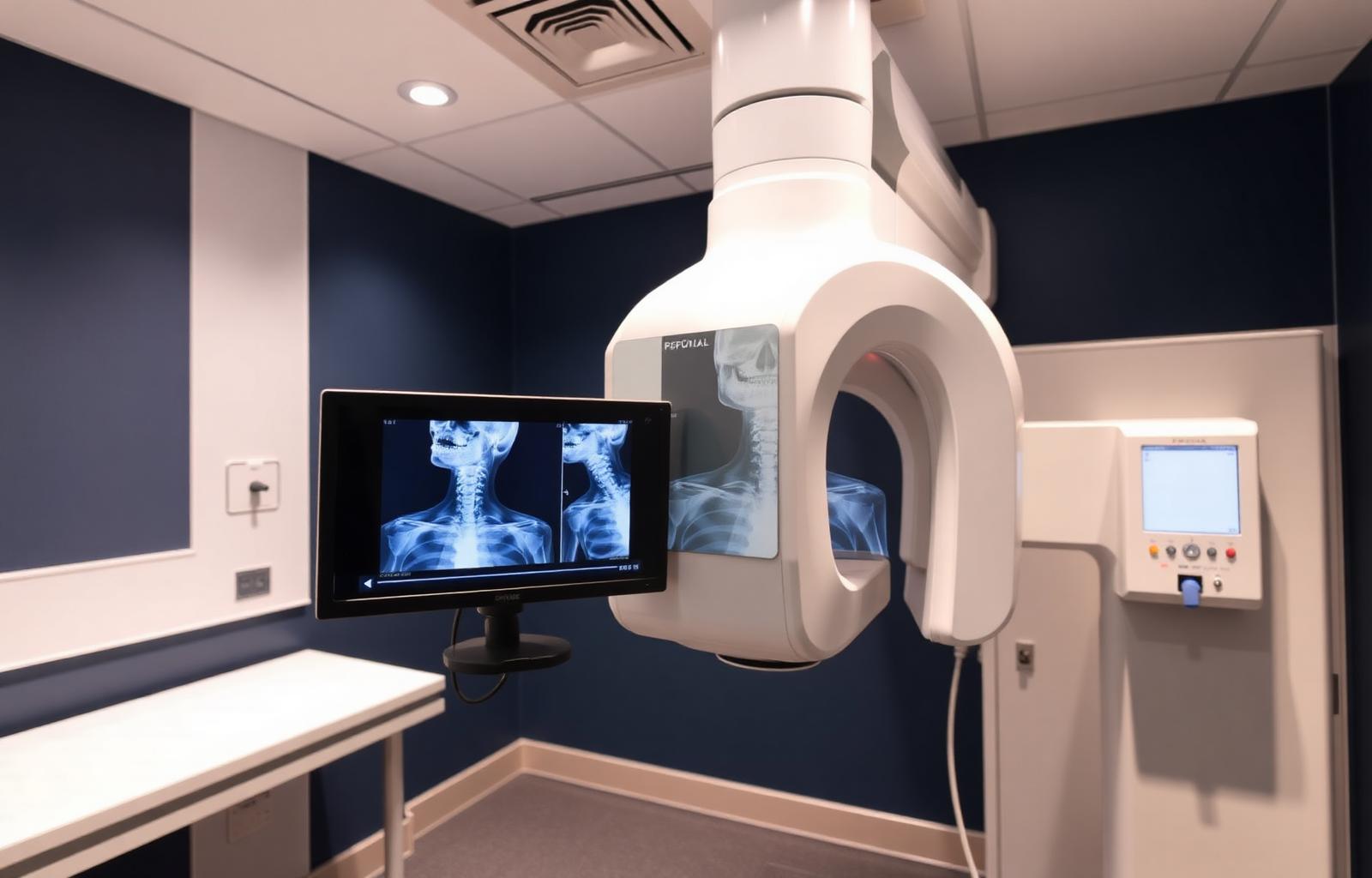
Real-time fluoroscopy of the spine in motion.
Digital Motion X-Ray is a low-dose fluoroscopic study that records the cervical spine on video as the patient moves through flexion, extension, and rotation. Instead of the single frozen snapshot a traditional X-ray produces, DMX captures roughly thirty frames per second - letting your provider review, frame by frame, how the vertebrae, joints, and supporting ligaments behave under load.
Video, not a snapshot
Standard X-rays freeze a single moment. DMX records continuous motion, so injuries that only appear during movement become visible on screen.
Low-dose digital fluoroscopy
Total radiation exposure for a complete cervical DMX series is comparable to a short series of standard X-rays - far less than a CT scan.
Frame-by-frame review
Your provider scrubs through the recorded study to identify abnormal vertebral translation, paradoxical motion, and ligamentous failure that static imaging cannot demonstrate.
Why static X-rays and MRIs often miss ligament injuries.
Traditional X-rays and MRIs are static - patients lie still while the image is taken. Cervical ligament damage doesn't always show up that way. The problem only becomes visible when the joint is asked to move and the injured ligament fails to control it. DMX is one of the few clinical tools that documents that abnormal motion objectively, which is why it is widely used to confirm injuries following motor vehicle accidents and whiplash trauma.

Ligaments fail under load
Alar, transverse, and capsular ligaments stabilize the cervical spine during motion. A torn or stretched ligament looks normal at rest and only reveals itself when the spine is moved.
MRI has known blind spots
Static MRI excels at disc and soft-tissue imaging but cannot demonstrate dynamic instability or the abnormal segmental motion that follows ligamentous injury.
Objective documentation
DMX produces measurable, reproducible findings that can be shared with attorneys, insurance carriers, and referring physicians as evidence of injury.
When we recommend a DMX study.
DMX is most useful when symptoms do not match what standard imaging shows, or when objective documentation of a cervical injury is required. We commonly order the study for patients with persistent neck pain after an auto accident, post-whiplash symptoms, headaches and dizziness with a suspected upper-cervical component, and ongoing instability that has not resolved with conservative care.
Post-accident neck pain
Neck pain that persists weeks or months after a motor vehicle collision often involves a ligamentous component that static imaging missed.
Whiplash & cervical instability
Whiplash-associated disorders frequently produce dynamic instability - exactly the type of injury DMX is designed to document.
Headaches & dizziness
Upper-cervical instability can drive cervicogenic headaches, dizziness, and visual disturbances. DMX helps determine whether the upper cervical segments are contributing.
Personal injury & legal cases
Attorneys and insurance adjusters frequently request DMX studies as objective evidence of cervical ligament damage following a traumatic event.
What to expect during a DMX appointment.
The study itself is quick. A trained technologist guides you through specific cervical movements while the fluoroscopy unit records. Your provider reviews the recorded video frame by frame and, when indicated, generates a written report that can be shared with your attorney, insurance adjuster, or referring physician.
Short, comfortable session
Most cervical DMX studies are completed in under twenty minutes. You stand or sit while the unit records - there is no enclosed tube and no contrast injection.
Detailed written report
Findings are documented with measurements, video stills, and a narrative report suitable for medical records, legal filings, or insurance submissions.
Integrated into your care plan
DMX is diagnostic, not therapeutic. Findings are used to build a corrective plan - typically chiropractic adjustments, Chiropractic BioPhysics structural rehabilitation, traction, MLS laser, and targeted strengthening.
Why Choose Virginia Family Chiropractic?
Few clinics in Northern Virginia offer in-house Digital Motion X-Ray. Pairing the study with on-site chiropractic, rehabilitation, and physical-medicine care means a single team interprets your imaging, builds your treatment plan, and delivers care - without referrals, repeat appointments, or fragmented records.

Specialized Diagnostic Imaging
One of the few Northern Virginia clinics offering Digital Motion X-Ray for cervical ligament evaluation, interpreted by providers who use the findings clinically every week.
Whiplash & Personal Injury Experience
Years of working with auto-accident patients and attorneys - our reports are structured to be useful in both clinical care and legal documentation.
Integrated Treatment Plans
DMX findings flow directly into your chiropractic, rehabilitation, and laser therapy plan under one roof - no referrals, no repeat intake.
Convenient Northern Virginia Locations
Care delivered at our Alexandria, Falls Church, Manassas, and Woodbridge offices, with the same providers and protocols at every location.
Chiropractic and Physical Medicine Services in Northern Virginia
Eleven specialized treatment modalities, delivered consistently across all four clinic locations.
Chiropractic Adjustments
Manual therapy and the Chiropractic BioPhysics protocol for herniated discs, scoliosis, postural dysfunction, and vertebral subluxation.
Chiropractic Pain Management
Multi-modal protocols for back, neck, shoulder, hip, knee, headaches, TMJ, and plantar fasciitis - rooted in structural correction, not pharmaceuticals.
Chiropractic Care for Injuries
Auto, workplace, athletic, and personal-injury rehabilitation with the clinical documentation insurance and legal proceedings require.
Chronic Conditions
Long-term management for arthritis, fibromyalgia, and chronic musculoskeletal pain. Sustainable function over short-term symptom suppression.
Laser Therapy
Cold-laser and Class IV therapeutic laser for tendonitis, bursitis, neuropathic conditions, and post-surgical recovery. No medication, no downtime.
MLS Laser Therapy
FDA-cleared dual-wavelength laser that pairs continuous and pulsed emissions to reduce inflammation and accelerate tissue repair.
Neurological Care
The NeuroMed program for diabetic and idiopathic neuropathy, carpal tunnel, drop foot, and postherpetic neuralgia.
Rehabilitation Services
Corrective exercises and functional movement training that retrain the muscular and ligamentous support structures of the spine.
Shockwave Therapy
Extracorporeal acoustic energy for chronic tendinopathies, plantar fasciitis, Achilles tendinopathy, and calcific tendinitis.
Dry Needling
Trigger-point needling for myofascial pain, muscle tension, and restricted range of motion - performed by certified clinicians.
Spinal Decompression
Computer-guided, non-surgical traction for herniated and bulging discs, sciatica, and pinched nerves - relieving pressure without injections or surgery.
Videofluoroscopy & DMX at four Northern Virginia locations.
Care is delivered with the same CBP-certified providers, the same diagnostic technology, and the same protocols across every office.
Videofluoroscopy & DMX in Alexandria
Alexandria, VA 22304
Videofluoroscopy & DMX in Falls Church
Falls Church, VA 22043
Videofluoroscopy & DMX in Manassas
Manassas, VA 20110
Videofluoroscopy & DMX in Woodbridge
Woodbridge, VA 22191
Frequently Asked Questions
Specific to videofluoroscopy & dmx. Call (703) 370-5300 to discuss your case.