

Studying late into the night puts real strain on your neck, back, and shoulders, especially if you're hunched over a laptop at a kitchen table or cramped desk in an Old Town apartment.
These essential posture tips for long study nights can help you avoid the neck strain, headaches, and upper back tightness we see regularly at our Alexandria office. Virginia Family Chiropractic & Physical Medicine has been treating posture-related pain since 2008, and our licensed chiropractors and physical medicine specialists know exactly what poor study setups do to your spine over time.
Key Takeaways
- The right posture during late-night study sessions can prevent cervical discomfort, headaches, and chronic back problems.
- Your screen should sit at eye level to keep your head from dropping forward while studying.
- Taking a short movement break every 30 to 45 minutes reduces spinal compression and muscle fatigue.
- Poor study posture left untreated can develop into chronic pain that requires professional chiropractic care.
- Simple setup changes, like raising your laptop and supporting your lower back, make a measurable difference.
Neck Pain From Studying? Your Posture May Be the Problem

Spending hours hunched over a laptop or textbook puts real stress on your spine. Poor posture compresses spinal discs, strains the muscles along your neck, and can trigger headaches that kill your concentration before the night is over.
In Alexandria, we see this constantly. Students cramming at the Beatley Library, remote workers at King Street coffee shops, federal employees finishing reports in Del Ray apartments. Many are sitting in chairs that were never designed for long study sessions, and their bodies pay for it.
Below are five practical tips for late-night study sessions, plus clear guidance on when desk discomfort needs professional attention. You can also read our broader advice on habits for a healthy back to build on what you learn here. Keep reading. Your neck will thank you.
Why Does Poor Study Posture Hurt More Than Your Back?

Poor study posture hurts more than your back because the forward-head position it creates overloads your neck first, then triggers a chain of problems that reaches your head, shoulders, and focus. Most students worry about back pain from sitting for hours, but the cervical spine takes the biggest hit, and understanding why helps you protect yourself before the damage adds up.
How Forward Head Posture Adds Load to Your Cervical Spine
Your head weighs roughly 10 to 12 pounds in a neutral position. For every inch it shifts forward from that neutral alignment, the effective load on your cervical spine increases by approximately 10 pounds. At a 45-degree forward tilt, your neck is bearing the equivalent of 49 pounds. That is the position most people hold while reading a textbook or scrolling through notes on a laptop screen.
The structures absorbing that load include your cervical discs, the levator scapulae, the upper trapezius, and the small suboccipital muscles at the base of your skull. Sustained compression on those discs over months or years can contribute to disc irritation and early degenerative changes. Students studying in non-adjustable chairs at the Charles E. Beatley Jr. Central Library on Duke Street, or hunched over a coffee table in a Rosemont living room, are sitting in exactly the conditions that accelerate this loading.
The Chain Reaction: Neck Strain, Headaches, and Concentration Loss
Tight suboccipital muscles do not just cause local soreness. They refer pain directly into the base of the skull, producing tension-type headaches that most people mistake for stress. If you are getting frequent headaches during study sessions, posture is a likely contributor. Musculoskeletal factors can overlap significantly with head pain, and cervical involvement is often overlooked as a contributor.
Prolonged forward flexion also reduces blood flow to the surrounding tissues and creates low-grade nerve irritation. Research consistently links this nerve irritation to measurable drops in focus and reading retention. Study-related neck strain is not just uncomfortable. It actively works against you. If cervical compression is already causing disc-related symptoms, our team offers chiropractic adjustments that address the root cause rather than masking the pain.
Simply put, bad posture does not just hurt your back. It costs you focus, sleep quality, and hours of productive study time.
Not sure if your posture has already caused damage? Schedule a spinal assessment at our Alexandria office.
5 Essential Posture Tips to Keep Your Spine Safe During Long Study Sessions
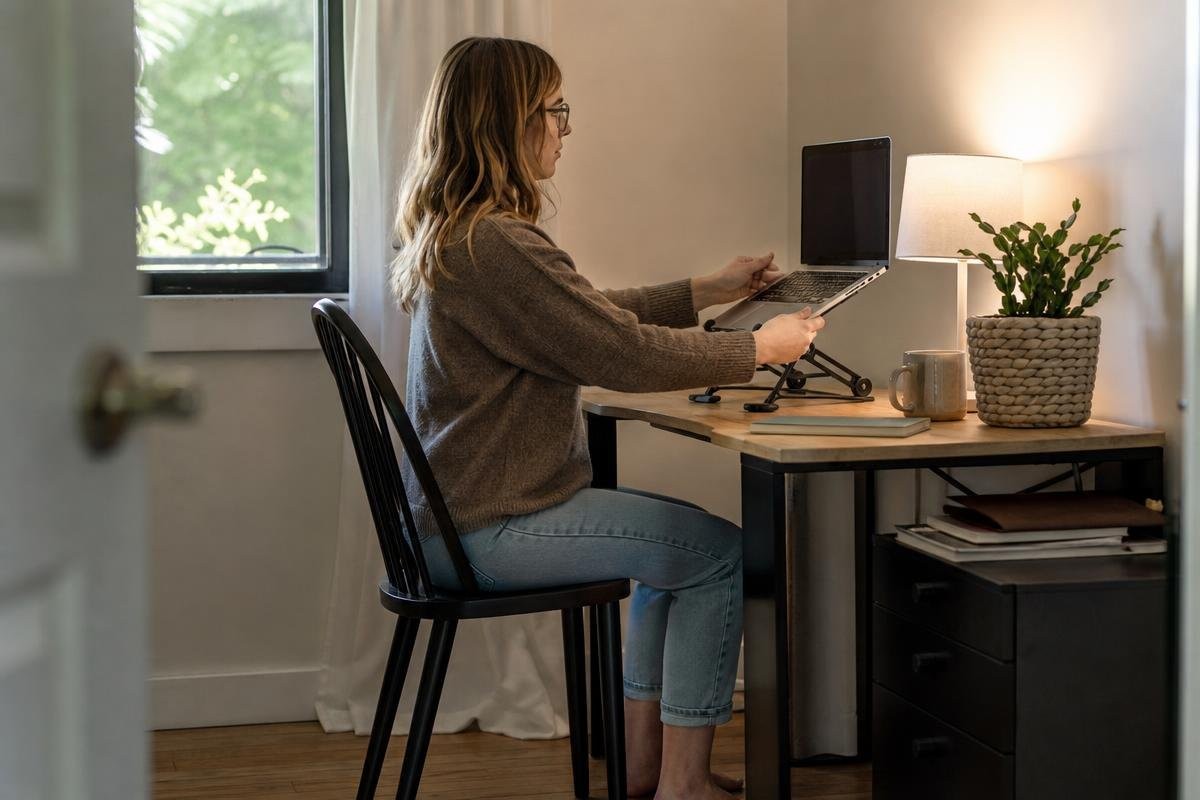
These study posture tips work whether you're at a proper desk or propped up on a dining chair in a home office in the West End. Small adjustments add up. Here is exactly what to change right now to maintain the right posture during studying.
Tip 1: Raise Your Screen to Eye Level
This is the single most important adjustment you can make today. Your screen top should align with your eye level so your gaze is level or angled slightly downward. If you use a laptop, prop it on a stand or stack of books and plug in an external keyboard. Looking down at a flat laptop for hours loads the neck with up to 60 pounds of force.
- Screen top at or just below eye level
- Arm's length distance from your face
- External keyboard when using a stand
- No laptop flat on your lap
Tip 2: Plant Your Feet and Square Your Hips
Both feet should rest flat on the floor. Your hips and knees should each sit close to a 90-degree angle. Crossing your legs or tucking one foot under you twists the pelvis and strains the lower back. If your chair runs tall, use a footrest or a sturdy book under your feet.
- Feet flat, not crossed or tucked
- Hip and knee angles near 90 degrees
- Footrest if chair height demands it
- Hips pushed back to the chair's rear edge
Tip 3: Support Your Lumbar Curve
Your lower spine has a natural inward curve. Most dining chairs and coffee-shop seats flatten that curve completely. Roll up a towel or grab a lumbar roll and place it at the small of your back. This one fix reduces disc load and is part of a broader approach to chiropractic rehabilitation we use with patients whose posture problems have already progressed.
- Rolled towel or lumbar pillow at the small of the back
- Support positioned at the belt line, not mid-back
- Chair reclined slightly (100 to 110 degrees) if adjustable
Tip 4: Move Every 30 Minutes
Sustained static posture does more damage than occasional slouching. Set a timer for 30 minutes. When it goes off, stand up, walk briefly, or do five shoulder rolls and a chin tuck. This is evidence-based guidance, not a suggestion. Our team recommends it to every patient asking how to maintain posture during studying over long stretches. For more ways to protect your spine day to day, see our guide on habits for a healthy back.
- 30-minute movement timer
- Stand or walk for 1 to 2 minutes
- 5 shoulder rolls plus a chin tuck
Tip 5: Position Your Keyboard and Mouse Correctly
Your elbows should sit at roughly 90 degrees with your shoulders relaxed, not shrugged. Keep the mouse close to the keyboard so you are not reaching forward. Wrists should stay neutral, not bent up or down. Reaching for a mouse placed too far away is a common cause of shoulder and neck tension we see in remote workers across Alexandria.
- Elbows at 90 degrees, shoulders down
- Mouse directly beside the keyboard
- Wrists flat, not angled up or down
- No keyboard on the edge of a table forcing a reach
Simple Stretches to Do Right at Your Desk
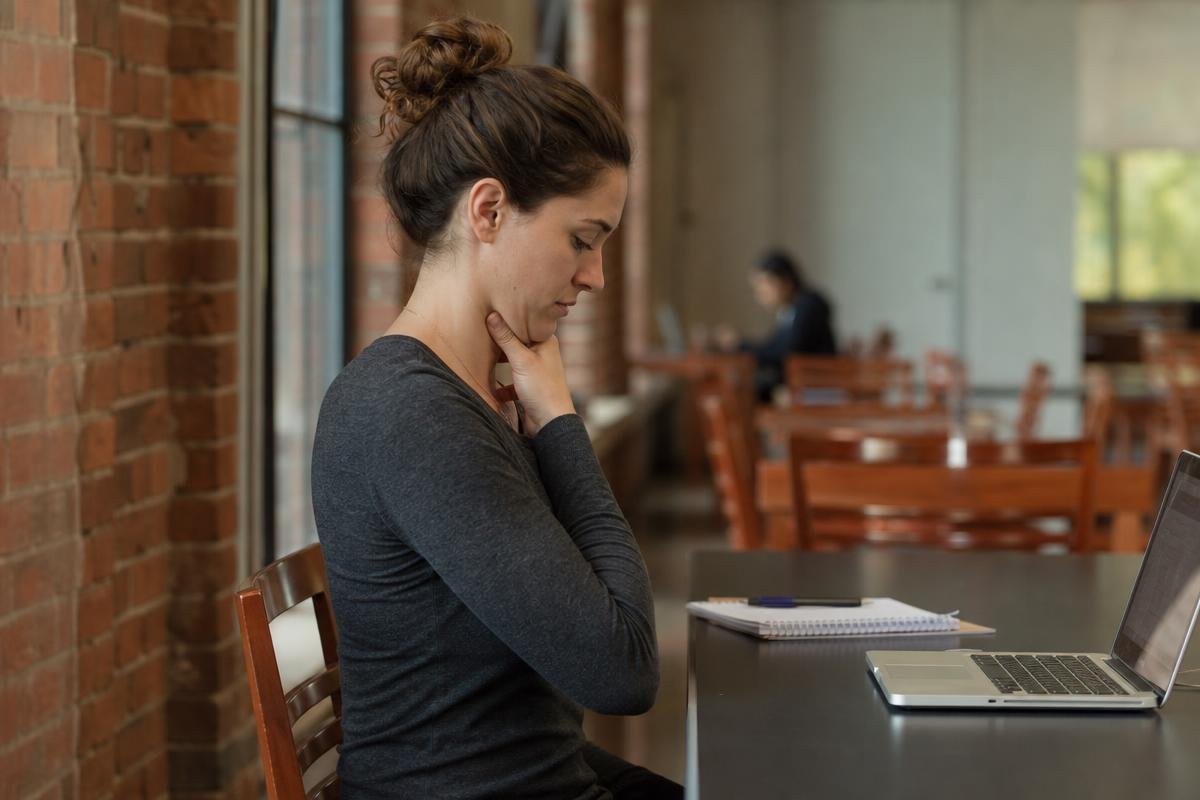
Cervical discomfort from desk work builds up fast. After two or three hours of reading, your cervical spine, thoracic joints, and hip flexors are all under load. These three stretches target those exact areas. You can do all of them without leaving your chair, which matters if you are settled in at the Beatley Library on Duke Street or a King Street coffee shop with no room to move.
Chin Tucks and Cervical Retractions
Start here if your neck is already stiff. This is the most direct counter to forward head posture.
- Sit tall with your back against the chair.
- Draw your chin straight back, not down. Think of creating a double chin.
- Hold for 3 to 5 seconds.
- Release slowly. Repeat 10 times.
This movement targets the deep cervical flexors and suboccipital muscles at the base of your skull. Those muscles get overstretched when your head drifts forward toward a screen. Ten reps takes under two minutes and resets your neck position immediately.
Thoracic Extension Over a Chair Back
Prolonged sitting stiffens the mid-back, compressing the thoracic erectors and intercostal muscles between your ribs.
- Roll a jacket or small towel and place it along the top of your chair back at mid-thoracic level.
- Cross your arms over your chest or lace your hands behind your head.
- Lean back gently over the roll.
- Hold 10 to 15 seconds. Repeat 3 times.
You should feel a gentle opening across your upper and mid-back. This mobilizes the same spinal segments that compress when you hunch over notes for hours. Keep the movement slow and controlled.
Hip Flexor and Seated Piriformis Stretch
Sitting at 90 degrees for hours tightens the hip flexors and piriformis muscle deep in your glutes. Back pain from sitting at a desk often starts here, not in the spine itself.
- Hip flexor: Stand briefly, step one foot forward, press the back hip gently forward and down. Hold 20 seconds per side.
- Piriformis: Stay seated, cross one ankle over the opposite knee, sit tall, and lean forward slightly. Hold 20 to 30 seconds per side.
If tightness in your hips or lower back does not ease with regular stretching, that is a signal worth taking seriously. Persistent restriction often responds well to chiropractic adjustments that address the joint mobility stretching alone cannot restore.
When Study Discomfort Becomes a Clinical Problem
Warning Signs That Go Beyond Normal Muscle Fatigue
Study-related neck strain or back pain from sitting at a desk for hours is common. Most of the time, rest and a few stretches clear it up. But some symptoms signal something more serious is happening. Seek a professional evaluation if you notice any of these:
- Pain radiating down your arm or leg
- Numbness or tingling in your hands or fingers
- Headaches starting at the base of your skull that do not ease with rest
- Pain that persists more than three days after fixing your workstation
- One shoulder visibly higher than the other
These symptoms can point to cervical disc irritation, nerve compression, or early-stage postural asymmetry. Left untreated, they tend to get worse, not better. If you notice visible changes in how you hold yourself, that is worth a clinical look for signs of scoliosis.
How We Treat Posture-Related Pain
Virginia Family Chiropractic, founded in 2008, takes a root-cause approach to posture-related pain. We do not just treat where it hurts. We find out why it hurts and correct that. Our board-certified team has earned 1,934 reviews at 4.9 stars from patients across Alexandria and Northern Virginia. Depending on your exam findings, treatment may include:
- Chiropractic adjustments to restore cervical and lumbar alignment
- Cervical decompression to relieve disc compression in the neck
- Dry needling to release tight postural muscles that stretching alone cannot reach
- Chiropractic rehabilitation to rebuild the strength that keeps good posture automatic
Patients travel to our Alexandria office from Falls Church, Manassas, and Woodbridge for this kind of individualized, drug-free care. We are located at 50 S Pickett St STE 114, Alexandria, VA 22304, accessible from multiple Northern Virginia corridors. If your discomfort has lasted more than a few days, make an appointment and let us take a look. Simply put, we want you to feel better.
Posture Habits for Alexandria Students and Remote Workers
Study Environments Around Alexandria That Create Posture Challenges
If you study in Rosemont, Old Town, or Woodbridge, your desk setup is probably improvised. Compact apartments mean kitchen tables, couches, and beds become workstations. None of these support your spine the way a proper chair does.
Coffee shops along the King Street corridor and the Charles E. Beatley Jr. Central Library are popular study spots. The seating at both is fixed and non-adjustable. You cannot raise the chair height or add lumbar support. That means you are responsible for maintaining the right posture during studying, without any help from the furniture.
A few simple fixes help when you cannot control your environment:
- Rolled jacket or sweater placed behind your lower back for lumbar support
- Laptop riser or stacked books to bring the screen to eye level
- Feet flat on the floor, not crossed or tucked under the chair
- Sitting at the front half of the chair to avoid slouching into the backrest
Studying on a couch or bed is the worst option for your spine. Both surfaces eliminate lumbar support entirely and push your lower back into a rounded position for hours at a time.
Building a Long-Term Posture Routine That Sticks
Knowing how to maintain posture during studying is one thing. Doing it consistently is another. One good session does not correct months of bad habits. You need daily structure. Start with these four habits:
- Set a phone alarm every 30 minutes as a posture check reminder
- Use a posture reminder app during long study blocks
- Alternate sitting and standing if a standing desk or counter is available
- Schedule a chiropractic evaluation at the start of each academic semester
Posture correction is not a one-time fix. Patients of all ages and abilities need individualized care plans that adjust over time. Our team at 50 S Pickett St STE 114 works with students and remote workers from across Northern Virginia to build plans that fit real schedules.
If you want professional guidance, a chiropractor in Alexandria can assess your spine and identify specific imbalances before they become chronic. You can also review our resource on habits for a healthy back to build on what you learn here.
Frequently Asked Questions
What is the right posture to maintain while studying?
The right posture while studying means ears over shoulders, shoulders over hips, and your lumbar curve supported by your chair. Your screen should sit at eye level, and your feet should rest flat on the floor. This alignment distributes load evenly across your spinal discs instead of concentrating stress on one area.
How often should I take breaks during a long study session?
Stand up every 25 to 30 minutes. Even 60 to 90 seconds of movement reduces disc pressure significantly. The Pomodoro technique, 25 minutes of focused work followed by a 5-minute break, lines up well with what your spine actually needs during long study nights.
Can bad posture during studying cause long-term spine damage?
Yes, over time it can. Chronic poor posture contributes to disc degeneration, altered spinal curvature, and muscle imbalances that become harder to reverse the longer they go unaddressed. Early posture correction gives you the best chance of preventing those changes from becoming permanent.
What should I do if I have neck pain or headaches after studying?
Apply ice to the neck for 15 to 20 minutes and try gentle chin tucks. Step away from your screen and rest. If symptoms do not improve within 48 to 72 hours, or if you notice numbness or tingling into your arm, see a chiropractor. Same-week appointments are available for patients in the Falls Church, Manassas, and Woodbridge areas as well as our Northern Virginia locations.
Does chiropractic care help with posture problems from desk work?
Chiropractic adjustments restore spinal alignment, reduce joint restriction, and relieve muscle tension that builds up from prolonged sitting. Many patients report improved neck mobility and reduced headache frequency after a course of care. Chiropractic is not just for acute back pain. It addresses the underlying joint and muscle dysfunction that poor study posture creates.
How long does it take to correct posture with chiropractic treatment?
It depends on how long the problem has been developing and how significant the misalignment is. Many patients notice reduced pain and better mobility within the first few visits. Structural correction of spinal curvature typically requires a longer, individualized care plan. Our team uses specific clinical approaches to address deeper curvature changes when needed.
Simply put, we want you to feel better.
Ready to Get Started with Virginia Family Chiropractic & Physical Medicine?
Your spine does not get a semester break. If stretching and workstation adjustments have not cleared your neck pain or headaches within a few days, our team is ready to help. Call Virginia Family Chiropractic or book online to schedule your evaluation at our Alexandria office at 50 S Pickett St STE 114. Same-week appointments are available for patients across Falls Church, Manassas, and Woodbridge. The sooner you address posture-related pain, the easier it is to correct.